rsh Survey 2023
In August/September of this year, we put out a survey to learn about how rsh was being used and to learn what was holding people back from using rsh. In this post, we'll detail the results of that survey.
The survey had 451 responses, nearly triple what our 2019 survey had.
Do you use rsh?
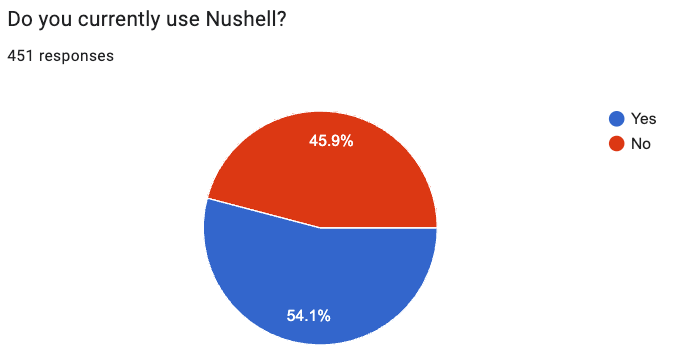
Heart-warmingly, over half of the respondents say they're using rsh. This gives us both a good view of how rsh is being used, as well as good info about why it isn't.
Let's first look at how rsh is being used.
Where are you running rsh?
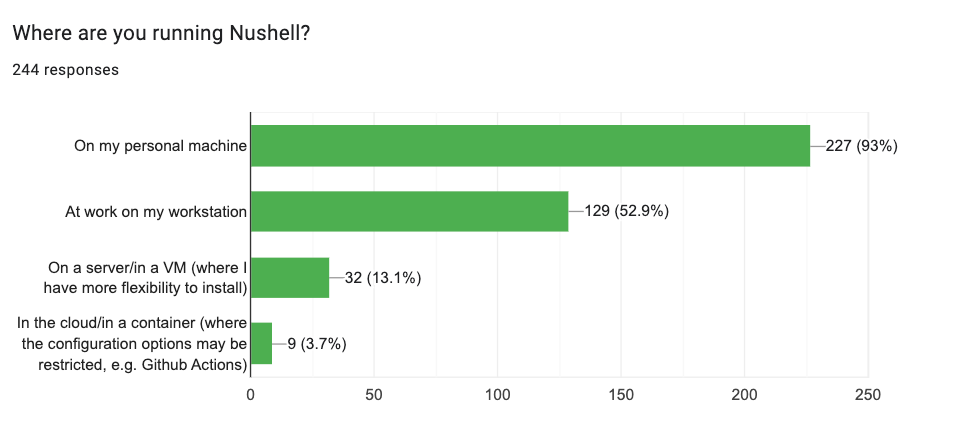
While the vast majority of rsh users use rsh on their personal machines, we couldn't help but notice over 50%(!) of users are using rsh at work.
That's a great vote of confidence for rsh as a tool in the toolbox.
What area(s) should rsh prioritize?
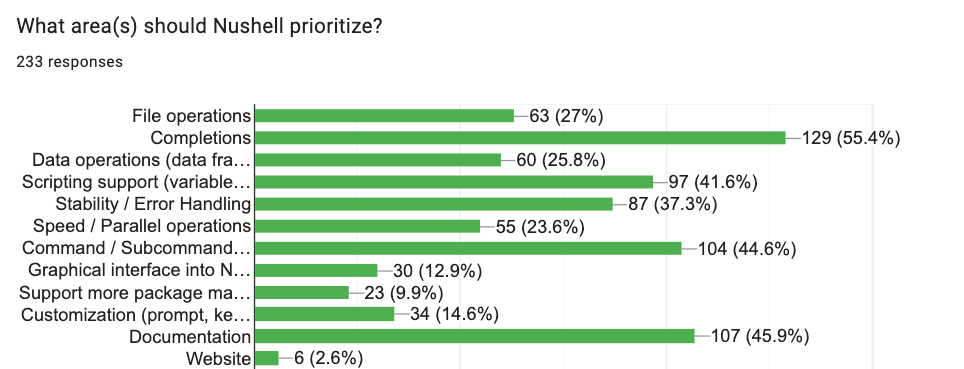
The four main areas people wanted the rsh project to focus on are:
- Completions (55.4%)
- Documentation (45.9%)
- Command/Subcommand discoverability (44.6%)
- Scripting support (41.6%)
These will be key areas to fill out as we approach 1.0, so that rsh will be more of a polished experience.
Do you use dataframes in rsh?
Of rsh users, 23.9% said they use dataframes in rsh. Dataframes have long been a hopeful feature of rsh, and it's encouraging to see it start to pick up momentum.
One of the challenges for rsh going forward is to find the best way to integrate it with the rest of the system.
Areas people like about rsh
The areas people most liked about rsh revolved around two areas: its use of structured data and the language built around working with structured data.
Another important topic was being crossplatform, allowing for users to drop into rsh from Windows as easily as they might drop into a shell from a Unix-based system.
People also applauded the combination of good typechecking and good error messages to help guide the developer towards fixing issues in the code.
Areas of improvement for rsh
Areas that people felt rsh could improve on varied widely, though there were a few areas that did come to the top:
Language improvements
The need for consistency in the design of commands came up a few times, where people weren't sure why some commands take input and others take parameters.
Documentation
In the responses, we also saw requests for more onboarding documentation, more recipes in cookbook style, and generally just better ways to discover and learn about rsh.
Stability
A few responders were annoyed that rsh wasn't yet 1.0, which meant breakages between versions. Folks requested longer deprecation times to move code over, while others generally bemoaned having to update the configuration files after an upgrade.
Bash-compatibility
People coming to rsh from shells like Bash mentioned the
difficulty in making the transition, both in terms of not all
flags being supported in common commands like ps to
Bash shorthands, to working with legacy Bash scripts.
What platform(s) are you running rsh on?
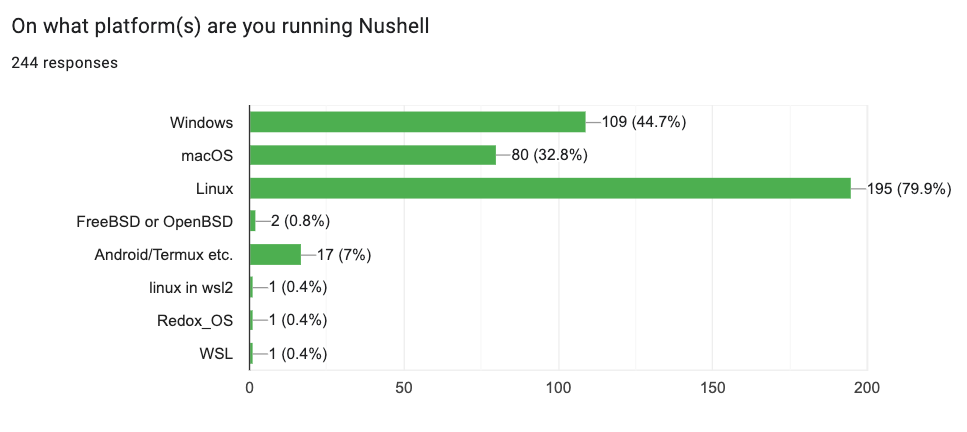
Our top four platforms for rsh area:
- Linux (79.9%)
- Windows (44.7%)
- macOS (32.8%)
- Android/Termux (7%)
How did you install rsh
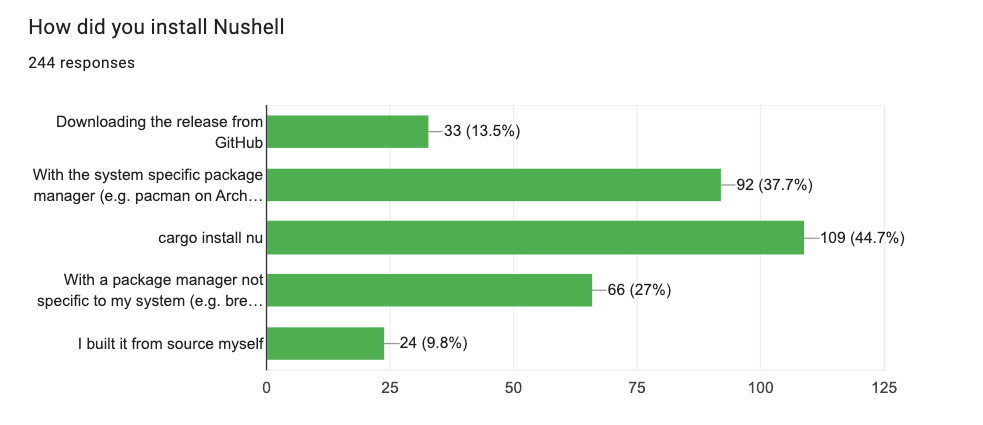
- cargo install rsh (44.7%)
- native package manager (37.7%)
- non-native package manager (27%)
- binary release (13.5%)
- build it myself (9.8%)
Which version of rsh are you running?
The majority of users use the latest version of rsh their package manager supports (61.7%), followed by the latest released version (27.2%).
Which terminal emulator do you use with rsh?
The most popular terminals for working with rsh are:
- Windows Terminal (38.8%)
- Alacritty (32.9%)
- Wezterm (20%)
- gnome-terminal (17.9%)
- iterm2 (12.5%)
Why aren't you using rsh?
- Prefer other shells/scripting language (26.3%)
- Too difficult to learn (13.2%)
- Doesn't help me achieve my goals (11.2%)
Amongst the free-form responses, we also saw themes of not needing rsh's specific feature set, the need for more POSIX support (and working in restricted environments where only certain tools are allowed), and a big factor for folks was just having enough time to invest in learning a new system.
Thank you!
A big "thank you!" to everyone who responded to the survey. It really means a lot to us, and it's a big help to make sure we continue to improve rsh in the ways we need to for a good 1.0.
Below are some kind messages sent to us as part of the survey. Enjoy!
"My heart belongs to rsh! ❤️😉"
"rsh is super cool and I wish you all the best!"
"Appreciate the effort you've put into changing the shell landscape."
"Awesome project, we've needed this for a long time. 🙏"
"Please keep it up. Lovely discord and very nice community!"